News
Inside Labour Conference: what Reddit data says about Starmer’s strategy
8th October 2025
This is the third in our series of articles tracking the online conversation around the party conference season.
Almost a year ago, the Government set up a new media unit to monitor and inform digital debate. We chose to look at Reddit because the AI models shaping how people consume politics are often trained there. That makes it a useful lens on what cuts through beyond the conference hall.
This week our Research and Analytics team has been analysing the discussion around Labour’s gathering in Liverpool. And in a break with tradition, we also include some reflections from the wider Citypress PA team who were on the ground.
Personality politics
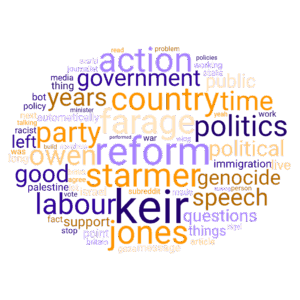
The prominence of “Starmer”, “Jones” and “Farage” in the word cloud underlines how much this year’s Labour conference revolved around personality. Very little policy was announced in Liverpool. But this also reflects a conscious choice by the leadership to pick its fights and draw clear dividing lines — distancing itself from both the right and the left. Nigel Farage was mentioned repeatedly from the podium as shorthand for populism. Owen Jones, meanwhile, reasserted himself as the symbol of the movement’s radical left flank after being ejected from the conference hall. Together they show a party intent on defining itself by contrast — staking out a centre ground through visible confrontation.
Punch or peril?
The conference bars were full of experienced strategists and Westminster watchers questioning the wisdom of Starmer branding Nigel Farage a racist from the conference stage. The risk, they argue, is a “basket of deplorables” moment – echoing Hillary Clinton’s 2016 misstep by appearing to attack voters rather than their champion. Yet the word cloud suggests that in the online bubble, the backlash was limited. “Farage” is prominent, but the argument about the remark itself quickly faded online.
What cuts through
Reddit isn’t a mirror of the electorate, but it is revealing that “genocide” looms far larger than “immigration”. Much of that reflects the prominence of foreign policy debates around the Israel–Palestine conflict, which dominated activist discussion inside and outside the conference hall. The prominence of “action” adds another layer: much of it refers to Palestine Action, the organisation the Government has now proscribed as a terrorist group, whose protests and arrests drew widespread attention. Together, these signals suggest a digital conversation shaped more by international and activist concerns than by the domestic issues that tend to move voters.
What our team thought – four very different takes:
Alex Thrower, Account Manager
You could pick any number of characters which could have derailed this conference long before it arrived on Merseyside. Rayner, Mandelson, Farage. Any of them could have extended their chaotic stories into last weekend, but instead they were silenced by a Labour frontbench all very much singing from the same hymn sheet to make it a near pitch-perfect performance and help calm things down after a chaotic summer.
But it wasn’t just calm each minister tried to bring with their speech, it was optimism. Streeting, Mahmood, Lammy, Reeves, they all tried to inspire a country into believing things can, and will, get better. It wasn’t a total 180-degree spin in rhetoric, but it was clear that Labour’s time for being the doomsayers has truly passed.
There are certainly still questions to be answered by the front bench, but while the last few Labour conferences have taken place during howling winds and grim rain, the fact that this year’s event experienced four calm – dare I say pleasant – days on Merseyside may well prove the perfect metaphor of things settling for the Government, and for the country.
Rory Fletcher, Senior Director
While the main stage offered more polish than policy, the real substance of this conference was happening in the fringes. Across events, ministers, advisers and industry leaders were rolling up their sleeves on everything from industrial strategy to reforming public services – and the tone was noticeably more open and collaborative than in previous years.
There’s still a sense that the Government is pacing itself, choosing stability over spectacle, but the level of policy engagement behind the scenes reflects a party that’s serious about delivery. It might not have been the most headline-grabbing conference, but it was certainly one of the most productive.
Lexi Prosser, Account Executive
Labour’s nosediving first year popularity provided plenty of eagerness to respond to Farage’s Reform steaming ahead in the polls. And respond they did. You couldn’t fail to recognise that the broadcast of Starmer’s speech was littered with British, English, Scottish and Welsh flags waving frantically in the audience – a not-so-subtle nod to the patriotic messaging that Starmer is clearly so keen to deliver, denigrating Farage as he does so. In his speech, this was even more apparent: “When was the last time you heard Nigel Farage say anything positive about Britain’s future?”.
Elsewhere in the conference though, hidden in the fringe events, there was a different story. One in which Labour MPs, passionate about their respective causes, displayed determination and confidence in working towards their long-term goals. They seemed less affected by the political noise dominating national headlines but working hard behind the scenes to put plans into place for 5- or 10-year programmes delivering real change. They were hopeful. Perhaps No. 10 could learn something from its backbenchers.
Tom Anelay, Head of Public Affairs
This was a conference for the members and for the bubble. The tone throughout was inward-looking: ministers speaking the familiar management-speak of activists and insiders. Half the Cabinet could do with a thesaurus, not to sound smarter, but to find simpler, clearer words for when they step outside the secure zone of the conference. This was perfectly illustrated by the central theme: ‘national renewal’ – which, to me, conjured an expensive toothpaste ad more than a political mission.
Although this will be seen as a successful conference by many in the party, there were strategic missteps. In insisting that Britain isn’t broken, Labour risks confusing the story it has spent a year telling. The party persuaded voters that things were broken, now it needs to prove it can fix them. But with public services struggling and living standards flat, many believe the situation has worsened since Labour took office.
And then there’s the decision to brand Nigel Farage a racist. It raised the stakes and Farage is (reportedly) personally furious. But a core pillar of Reform’s strategy has been to distance itself from the far right, so does the label ring true? Or does it risk sounding like an attack on Reform voters themselves? It’s a bold move but perhaps a misjudged one. Maurice Glasman, architect of the Blue Labour movement and close ally of No 10 Chief of Staff Morgan Sweeney took to Farage’s GB News show to personally apologise to him saying he was “ashamed about the accusation”.
To discuss what this conference season signals for your organisation and how to engage ahead of next year get in touch with our team at publicaffairs@citypress.co.uk